The Expedition Challenge: Your Capstone Mission to Mastery
This is not a lesson; it's a mission. Apply your systems to design and execute a solo multi-day expedition. Download the "Expedition Guide" and join the elite
Your Expedition Guide
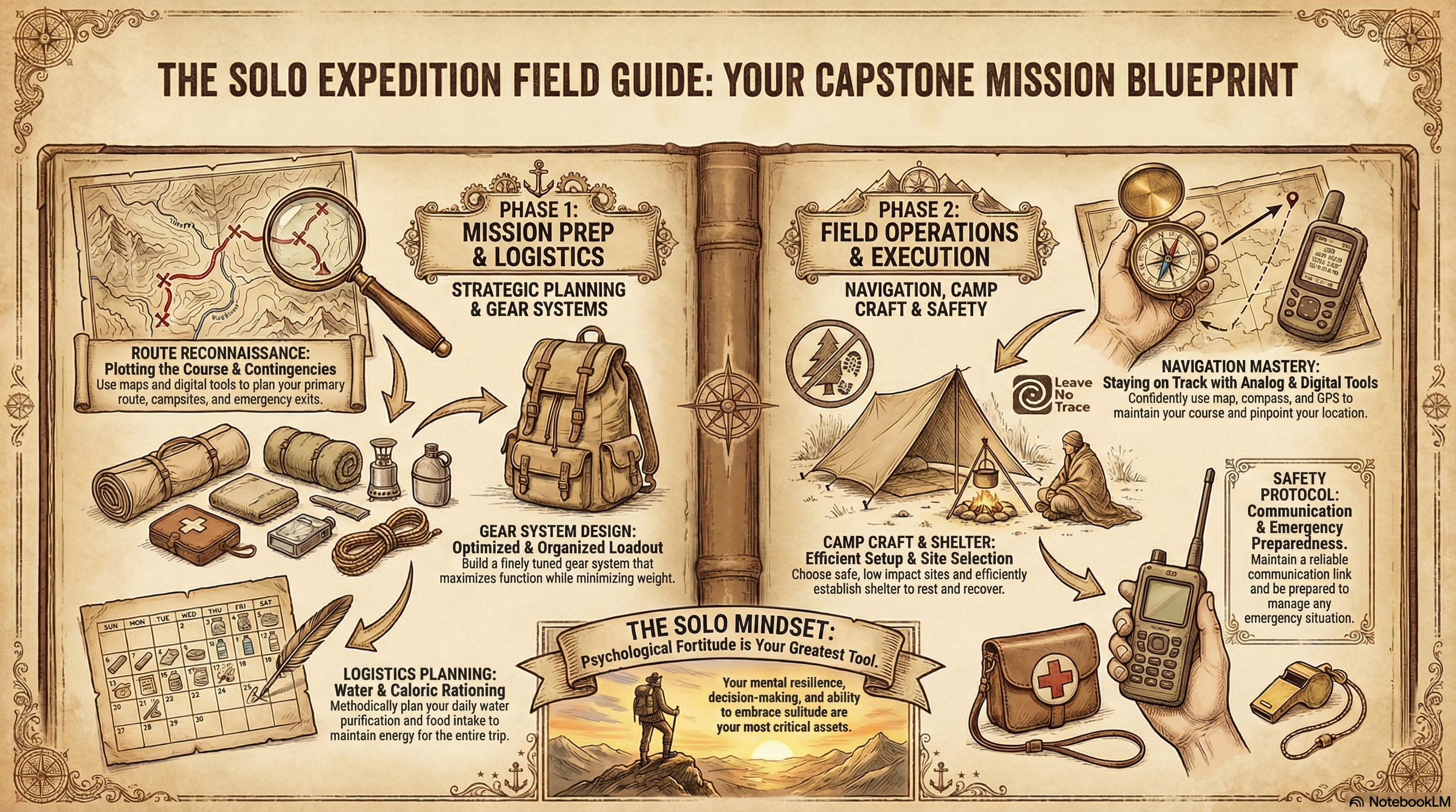
Your Mastery Roadmap: 12 Modules to Confidence
Module 1: Foundations of the Solo Expedition
Module 2: Route Reconnaissance & Scouting
Module 3: Gear System Design & Organization
Module 4: Navigation Mastery & Contingency
Module 5: Water & Food Logistics
Module 6: Camp Craft & Shelter Solutions
Module 7: Emergency Preparedness
Module 8: Communications & Safety Protocols
Module 9: Psychological Fortitude & Solo Mindset
Module 10: Ops Plan: Synthesis & Execution
Module 11: Pre-Expedition Checklists
Final Exam: The Mission Launch
Start Your Journey Today.
-
Start with the "5 Ws" and a Route Card. Define Who (team), What (objective), Where (route), When (season), and Why (goal). Create a daily Route Card that breaks the trip into "legs" with specific distances, elevation gains, and pre-planned "escape routes" for emergencies.
-
Use a Risk Matrix to prioritize prevention over reaction. Identify hazards (weather, terrain, wildlife) and rate them by "Likelihood" vs. "Consequence." For every high-risk hazard, create a specific protocol (e.g., "If wind exceeds 30mph, we camp immediately") so decisions are made logically, not emotionally, during the storm.
-
Poor group dynamics and communication cause more failures than gear breakage. "H.A.L.T." (Hungry, Angry, Lonely, Tired) destroys morale. Successful leaders establish a daily "debrief" routine to air grievances and check the team's mental state before small irritations become trip-ending arguments.
-
Train with a loaded pack (rucking) on uneven terrain, not just in a gym. You must build "functional endurance"—the stabilizer muscles in your ankles, knees, and core that handle weight over rough ground. Break in your boots at least two months before the start date to prevent crippling blisters.
© 2026 OUTDOOR WILDERNESS SKILLS. EST. 2026. STAY RUGGED.